
Why doesn’t your business show up when someone asks AI for the kind of help you provide?
Find out what’s actually going on before you start changing anything.
If AI tools know your business exists but leave you out, recommend others instead, or describe you inaccurately, you want to know why. Or better yet, if a new client says, "I found you through ChatGPT," an obvious question to ask is:
"If AI recommended me once, can we work out why and do more of whatever caused it?"
These all look like different problems, but they have something in common. There are too many variables behind a single AI result to say confidently what caused it.
That's exactly the kind of question the audit is there to investigate.
Why doesn’t your business show up when someone asks AI for the kind of help you provide?
Find out what’s actually going on before you start changing anything.

If AI tools know your business exists but leave you out, recommend others instead, or describe you inaccurately, you want to know why. Or better yet, if a new client says, "I found you through ChatGPT," an obvious question to ask is:
"If AI recommended me once, can we work out why and do more of whatever caused it?"
These all look like different problems, but they have something in common. There are too many variables behind a single AI result to say confidently what caused it.
That's exactly the kind of question the audit is there to investigate.
Not every search is asking the same thing
And what you ask changes what AI decides to surface
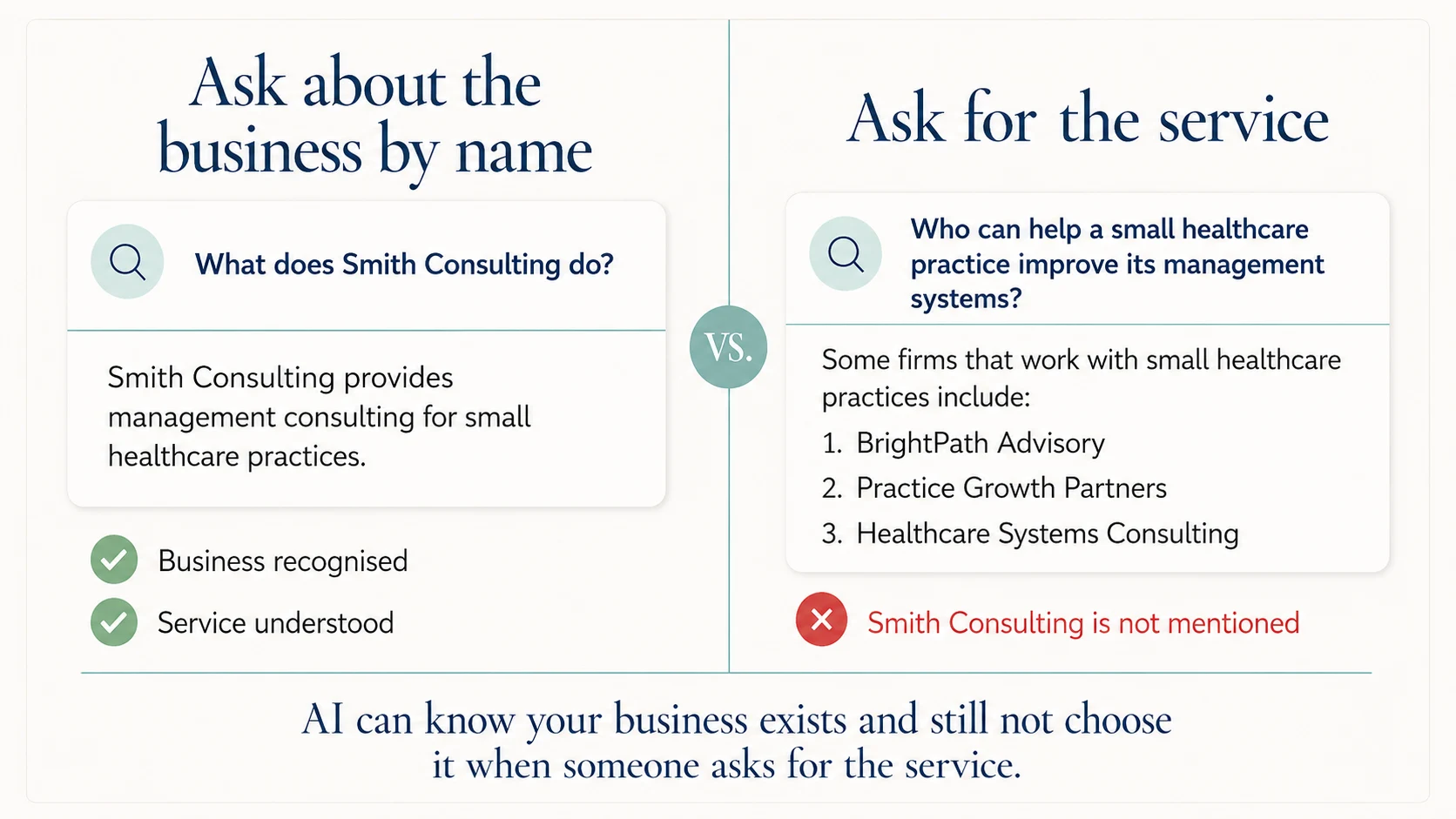
One reason AI visibility gets confusing so quickly is that not all searches are testing the same thing. Asking AI about your business by name can show that it recognises the business and understands what it does. Asking for the service is different.
That is where AI starts making a judgment about which businesses fit the need being described.
Why one AI result can’t tell you what to fix
You try again with slightly different wording, check another AI tool,
compare the businesses that keep appearing, and start looking for an explanation.
Before long, you've searched Google, asked ChatGPT why it chose them, and found yourself reading about SEO, GEO, AEO and AIO when all you really wanted to know was what was going on.
Then come the 'fixes':
more content
schema
reviews
different page structures
AI bots
FAQs
directories
third-party-mentions
An AI search result can show you what happened without telling you what caused it. One missing result, one recommendation or one dashboard score isn’t enough to tell you which page to rewrite, whether you need more content, or whether your website is even where the problem sits.
That’s why comparing yourself to the businesses that appeared can get expensive very quickly. They have more articles, different schema, more reviews, a bigger website or stronger conventional SEO, and suddenly every difference looks like an explanation.
But a competitor having 200 articles doesn’t mean you need 200 articles too. Before you spend time and money changing things, we need to know whether the pattern gives us a good reason to change them.
AI visibility isn’t one fixed ranking
AI visibility changes across platforms, questions, conversation context, and time.
That makes them harder to reverse-engineer than a conventional search result. You can ask almost the same question twice and get a different mix of businesses or find that ChatGPT includes you while Perplexity skips you altogether.
So, the job isn't to hunt for one missing ranking factor. It's to look for patterns across the searches that matter to your business and then follow those patterns back to the information that could help explain them.
1
Do you disappear altogether or only in certain situations?
2
Do the same businesses and competitors keep coming up?
3
Does one AI tool treat you very differently from another?
4
Is your business described accurately when it does appear?
This is why one search, one screenshot or one dashboard score can't tell you what to fix.
What does an AI Visibility & Accuracy Audit investigate?
It looks at where your business appears across searches for one priority service or offer.
Starting with one service matters because your business can be a strong match for one type of search and barely appear for another.
I use the kinds of searches a potential customer might make when they're looking for that service, then compare what happens when the wording or AI tool changes.
From there, we can follow the patterns rather than guessing from one result.
I'll look at:
your website,
the information other websites hold about your business,
the businesses being recommended instead
any mismatch between how you describe the service
how the wider web describes it, and also
which sources seem to be shaping the answers.
I don't decide in advance where the problem must be.
Instead, I follow what the results give me a reason to investigate.
If your Google Search Console account has access to the new Generative AI report, I’ll look at that too. It can show impressions from Google’s AI features, including which pages appeared and how those impressions break down by country, device and date.
You need to know what it doesn’t show:
click data, or
why your business was or wasn’t recommended,
whether it was represented accurately,
what happened in ChatGPT, Claude or Perplexity, or
what you should change because of it.
When the same businesses keep appearing
If the same businesses keep appearing instead of yours, it's an obvious choice to compare them.
But not by creating a giant checklist of everything they have that you don't, or you do differently.
They may have more directory listings, different schema, a bigger website, stronger SEO, or a dozen other differences. Any one of those can look convincing when you're searching for an explanation.
First, I need to look at how good the match is.
1
A business appearing in the answer doesn't necessarily mean it is a strong match for that search. It may offer something adjacent, be mentioned for a different service, or only loosely fit what the customer asked for.
2
So, the comparison needs to focus on the businesses that are genuinely strong fits. Then we can look at what those businesses have in common, how clearly they relate to that service, and whether the same differences keep showing up.
3
Are other websites clearly associating them with that service? Does their own website make that offer easier to recognise? And are we comparing the same kind of service, rather than assuming every business in the answer is competing for exactly the same work?
That gives me something much narrower to investigate than "they're doing more SEO" or "they have more content".
And sometimes the comparison points away from your website altogether.
When the problem isn't on your website
Outdated or conflicting information affects how AI describes your business.
Your website is one part of the picture. AI tools can draw on directory listings, profiles, articles, reviews and other public sources as well as your own website.
If those sources are clear and consistent, they reinforce the same picture. If they are outdated, vague, or describing an older version of the business, they can create contradictory supporting evidence about who you are, what you do, or which services you provide.
When the public information doesn't agree, an LLM has less reason to treat any one version as reliable enough to use or cite.
And even after you correct something, the old version doesn't necessarily disappear straight away. Search engines must revisit and reprocess changed pages, while AI tools can sometimes be working from cached copies that are weeks or even months old.
That means an inaccurate AI answer can sometimes reference information that has already been fixed, rather than a problem that still exists on your current website.
This becomes especially important when your current website is accurate, but AI is still describing the business incorrectly or connecting it with the wrong kind of work.
In that case, changing the homepage again may not solve anything. The contradiction may be elsewhere in the public information about the business.
What will you know at the end of the audit
After completing the audit, you should have a much clearer picture of what is happening around the searches we tested, which patterns keep repeating, and where the evidence is pointing.
If your business is missing from one search, I wouldn’t make too much of that on its own. If it keeps disappearing across several searches where you’d reasonably expect it to be considered, that’s a very different pattern. The same goes for accuracy. If AI repeatedly describes your business in a way that doesn’t match what you actually offer, we need to find out where that picture is coming from. A small wording issue on a page is different again. If it isn’t connected to the searches we’re investigating, there may be no good reason to change it at all.
From there, you'll know:
what I think you should change first
what can wait
what needs more evidence before you spend time on it
what I would leave alone
Sometimes the answer will be quite specific. Sometimes the pattern will be clear enough to narrow the problem without proving one exact cause. And sometimes the evidence won't give you a good reason to make a major change at all.
That last outcome matters too, because the audit is there to help you decide what is worth doing, not to manufacture a list of work so the report looks substantial.
When does an AI Visibility & Accuracy Audit make sense?
It makes sense when you have already checked how your business appears in AI, the results do not make sense to you, and you are no clearer about what to do next.
It's a good fit if:
Your business doesn’t appear when people ask AI tools for the kind of service you provide, even though you expected it to.
The same competitors keep being recommended and you want to know what’s different.
Different AI tools are giving different answers about your business and you can't tell what to make of them.
AI tools are describing your business, services or expertise inaccurately.
Your business ranks well in Google, but that visibility isn’t carrying across in the way you expected.
Someone found you through ChatGPT or another AI tool and you want to understand what seems to be supporting that recommendation before you try to reproduce it.
You’ve found plenty of advice about what you could change, but you still don’t know which of it has anything to do with your result.
You're thinking of paying for SEO, content, PR or website changes and want to know whether the evidence points there first.
You don’t need to know anything about GEO, AEO or AI optimisation before we start. What you do need is a result or pattern you want properly investigated before you put more time or money into trying to fix it.
You don't need to know where the problem sits before you book. That is what I'll try to work out for you.
What do you receive with an AI Visibility & Accuracy Audit?
It includes a written report, a personalised video walkthrough, clear priorities, and 7 days of email follow-up.
walkthrough
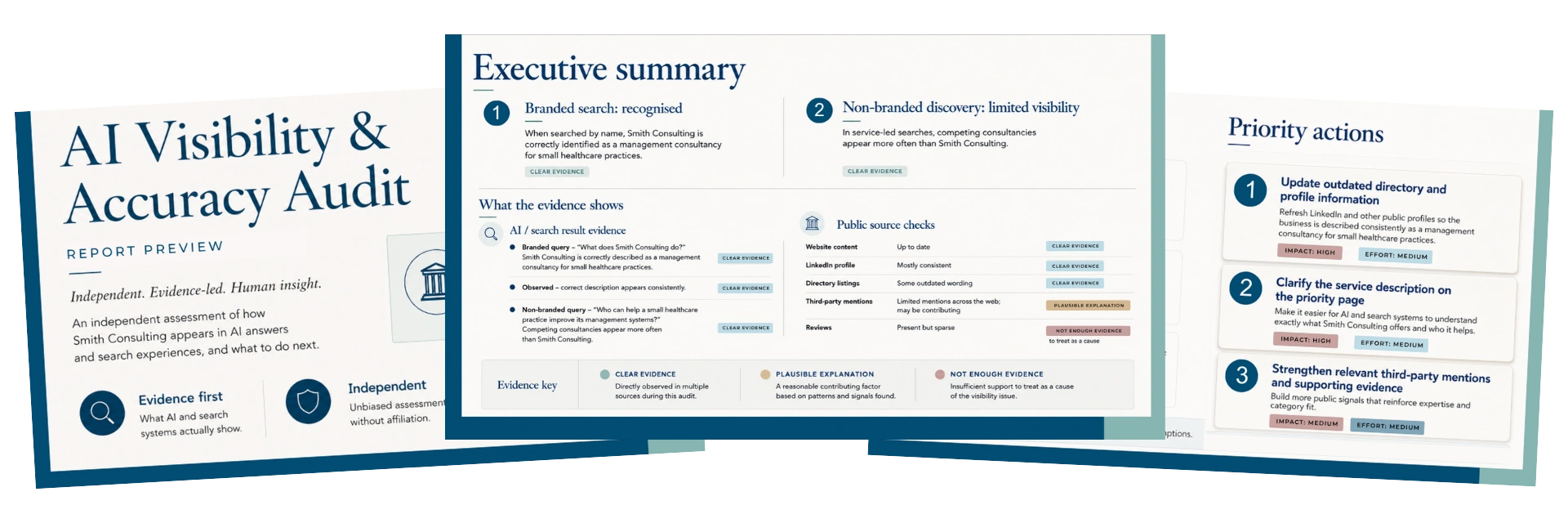
The written report brings the investigation together in one place.
It shows the searches and patterns that mattered, where the strongest mismatches appeared, what seems to support those results, and where the evidence is still too weak to draw a firm conclusion.
You'll also be able to see:
— What I think is worth changing first
— What can wait
— What needs more evidence
— What I would leave alone
I'll also record a personalised video walkthrough, because some of the findings are easier to explain properly than to squeeze into a paragraph. I can talk you through the grey areas, the reasoning behind the recommendations, and any parts of the result that need a bit more context.
And once you've had time to go through everything, you have 7 days of email follow-up for questions about the findings.
What this audit won't promise
I don't do a broader digital-marketing diagnostic. Every source I look at is tied back to the same question:
Why is this business being found, described or recommended this way in AI and search, and what does the evidence justify changing?
Areas where it could lead me to:
Reviews, because they can form part of the public evidence AI and search systems encounter.
Media and third-party mentions, because they can reinforce what your business says about itself or contradicts it.
Old or stale records, because outdated information can contribute to inaccurate or conflicting descriptions.
LinkedIn, directories and other public profiles, because they help establish who you are, what kind of business this is and what you currently offer.
AI tools and search platforms, because that is where the visibility or accuracy problem is showing up.
What I am not doing is auditing whether your Instagram strategy is working, whether your Meta ads are efficient, whether your conversion tracking is configured correctly, or whether a previous agency did a good job.
Those things may be important to your business. They simply aren't part of this investigation unless there is a clear reason they affect the visibility or accuracy problem we are trying to understand.
What do I need from you for the audit?
The setup is deliberately light. You won't need to prepare a huge bundle of documents or spend hours getting everything organised first.
20–30 minutes
Your form intake
I'll ask for the basics around the service we're investigating: your website, who the service is for, the main market you serve, anything you've already noticed in your own searches, and any competitors, directories or public profiles you think are relevant.
10 working days
The investigation
The delivery period begins once I have the completed intake and any additional information we have agreed I need. If something comes up once I start investigating and I need a little more context, I'll ask for it then.
7 days
Your follow-up
Once you have the report and video walkthrough, you have a week of email support for questions about the findings.
Pilot
price: $497
I’m offering the First5 AI Visibility & Accuracy Audits at $497.
You’re getting the full audit at the pilot price: the investigation, written report, video walkthrough, clear priorities, and 7 days of email follow-up.
I’m using these first 5 audits to tighten the delivery process before the standard price kicks in.
The standard price will be $1,495.
Book your Visibility Audit – get the First5 discountA few practical questions
No.
AI recommendations can change with the wording of the search, the tool being used, the context of the conversation and the information available at the time.
The audit can show you where your business is appearing, how it is being described, what patterns keep repeating and what the evidence gives you a reason to change. It can't guarantee what an AI tool will recommend afterwards.
No.
Your existing SEO may be part of what we look at, especially if your Google visibility and AI visibility are very different, but the investigation goes wider than SEO.
It also looks at the searches themselves, the businesses being recommended, how well those businesses match the search, your website, and the wider public information around your business.
If the evidence points towards an SEO problem, you'll know that. I don't start by assuming SEO is the answer.
No.
You can arrive with something as simple as:
"I keep searching for the kind of work I do, and other businesses appear instead of mine."
Or:
"ChatGPT recommended me to someone, and I have no idea why."
That is enough to start with.
The audit doesn't include implementation, and you don't have to hire me for anything afterwards.
You'll know what I think should change, where the issue sits and what I would deal with first. You can make those changes yourself, pass them to someone you already work with, or use the report to brief the right specialist.
I may suggest things such as content gaps, changes to an article structure, clearer wording on a page or information elsewhere that needs correcting, but I'm not using the audit as a way to create a second implementation job for myself. That separation matters because the whole point is to work out what the evidence gives you a reason to do before you spend more money on it.
Then I'll tell you.
The investigation may still uncover smaller inaccuracies, inconsistencies or areas worth keeping an eye on, but I'm not going to turn those into a major problem simply because you paid for an audit.
Sometimes the most helpful result is knowing that the evidence doesn't give you a good reason to start changing large parts of your website or spending money elsewhere.
Allow 10 working days from the point when I have your completed intake and any additional information we've agreed I need.
You'll then receive the written report and personalised video walkthrough, followed by 7 days of email support for questions about the findings.
Ready to find out what's really going on?
If your own searches have left you with more questions than answers, the audit will help you see where your business is showing up, how it is being described, what the patterns are telling us, and what I think is worth doing next.
New offer First5 price: $497